


You may wonder, how to make a NBFC in India? This process needs careful planning and strict attention to rules. You must first set up a company, meet the minimum capital requirement of Rs. 10 crore, and get approval from the Reserve Bank of India. As of March 31, 2023, India had 9,443 registered NBFCs, with most being non-deposit-taking. Many new businesses choose expert help from Nishtha Leasing Pvt Ltd for guidance and co-lending options. Use this guide to make your registration smooth and successful.
Key Takeaways
Registering an NBFC is important for legal work and getting money. It helps people trust your business and lets you join government programs.
Pick the right NBFC type for your business goals. Each type needs different money and has different jobs.
Get all needed papers ready very carefully. If you miss or mess up papers, your registration can take much longer.
Follow RBI rules after you register. This keeps your NBFC running and stops you from getting fines.
Think about hiring a professional to help you register. Experts can make things easier and help you meet all rules.
Overview of NBFC Registration
What is an NBFC?
You might see NBFC when you search about finance businesses. A Non-Banking Financial Company is made under the Companies Act. It acts like a financial institution. NBFCs give out loans and advances. They also invest in stocks and buy securities from the government or local groups. These companies do not have a banking license. Still, they are important in the financial system.
Why Register an NBFC?
You need to register your NBFC to work legally. Registration makes your company official and helps you follow RBI rules. When you register, you can offer more financial services. You can get money from banks and investors. You can also join government programs for financial inclusion. Here is a table that lists the main benefits:
Benefit | Description |
|---|---|
Legal Recognition | The RBI gives you permission to run your NBFC. |
Credibility | Customers, investors, and partners trust your company more. |
Access to Funding | You can get money from banks and capital markets. |
Wider Range of Services | You can give loans and other services to more people, even in villages. |
Legal Backing | Your financial deals follow clear rules. |
Government Schemes | You can use government programs and subsidies for NBFCs. |
If you run a finance business without registration, you face many risks. These risks include human mistakes, system problems, process errors, liquidity issues, and harm to your reputation.
RBI and Legal Framework
The Reserve Bank of India controls and checks all NBFCs. You must follow RBI rules to keep your NBFC safe. The RBI looks at your company’s capital, liquidity, and asset quality. It also checks your NBFC often. Here is a table that shows what the RBI does:
Aspect | Description |
|---|---|
You must register with the RBI to run your NBFC. | |
Prudential Norms | You need enough capital and must manage assets and liquidity well. |
Periodic Inspections | The RBI checks your NBFC to make sure you follow all rules. |
You must also follow other laws and guidelines. These include the Scale-Based Regulation Framework, Fair Practices Code, and Digital Lending Guidelines. These rules help your NBFC work fairly and protect borrowers. If you want to make a NBFC in India, you should learn about these laws and follow them closely.
How to make a NBFC in India: Step-by-Step Guide

If you want to know how to make a NBFC in India, you need to follow some steps. Each step is important for following the law and running your business well. Here is a simple guide to help you.
Choose NBFC Type
First, you have to pick what kind of NBFC you want. Your choice should fit your business plans and the services you want to give. Think about these things:
Match your business with the right NBFC type. For example, pick NBFC-ICC for lending or NBFC-Factor for invoice discounting.
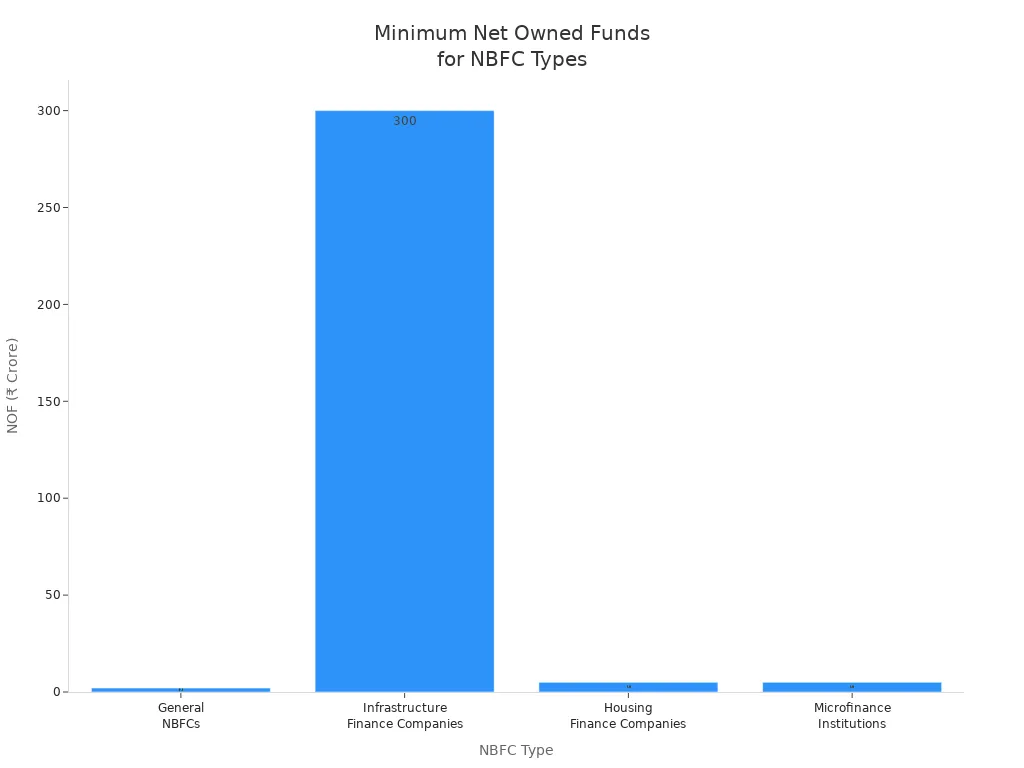
Look at the money and capital you need. Most NBFCs need ₹2 crore, but some, like NBFC-IFC, need ₹300 crore.
Study if your plan will work and talk to legal experts to make sure you follow all rules.
You can check the rules for different NBFC types in this table:
Criteria for types of NBFC | General NBFCs | Infrastructure Finance Companies (IFC) | Housing Finance Companies (HFC) | Microfinance Institutions (MFIs) |
|---|---|---|---|---|
Company Registration | Private or Public Limited Company under Companies Act, 2013 | Private or Public Limited Company under Companies Act, 2013 | Private or Public Limited Company under Companies Act, 2013 | Private or Public Limited Company under Companies Act, 2013 |
Minimum Net Owned Funds (NOF) | ₹ 2 Crore | ₹ 300 Crore | ₹ 5 Crore | ₹ 5 Crore |
Financial Activity as Principal Business | > 50% of total assets and income from financial assets | > 75% of total assets deployed in infrastructure loans | – | – |
Directors’ Experience | 1/3rd with at least 3 years of relevant financial experience | 1/3rd with at least 5 years of experience in infrastructure finance | 1/3rd with at least 5 years of experience in housing finance | 1/3rd with at least 3 years of experience in microfinance |
Clean CIBIL Record | Required for company and all directors | Required for company and all directors | Required for company and all directors | Required for company and all directors |
Business Plan | Detailed business plan for at least 5 years, including financial projections, target market analysis, and risk management strategies | Detailed business plan for at least 5 years, with specific focus on infrastructure projects and risk mitigation strategies | Detailed business plan for at least 5 years, focusing on housing affordability and loan delinquency management | Detailed business plan for at least 5 years, outlining client outreach, loan collection strategies, and social impact goals. |
You can also see the lowest net owned funds for each NBFC type in this chart:
Company Incorporation under Companies Act
You must make your company official under the Companies Act, 2013. You can choose a private or public limited company. Here are the steps you need to do:
Register your company under the Companies Act, 2013.
Write the Memorandum of Association (MOA) and Articles of Association (AOA). Make sure they show your main goal is financial business.
Make sure your company has the right amount of net owned fund.
Keep your CIBIL records clean and get all the papers and certificates you need.
Send your application online and mail a copy to the RBI regional office.
Wait for the Registration Certificate from RBI. This can take 2-3 months.
Obtain Certificate of Incorporation
After you register your company, you will get a Certificate of Incorporation from the Registrar of Companies. This paper proves your company is real. You need it for the next steps.
Meet Net Owned Fund Requirement (Rs. 10 Crore)
You must have at least ₹10 crore as net owned fund to register your NBFC. This rule started on October 1, 2022. Old NBFCs must meet this by March 31, 2027.
Requirement | Amount | Effective Date |
|---|---|---|
Minimum Net Owned Funds (NOF) | ₹10 crore | October 1, 2022 |
Existing NBFCs compliance date | ₹10 crore | March 31, 2027 |
You can get this money from different places:
Foreign direct investment (up to 100% under the automatic route)
External commercial borrowing
Loans from Indian financial institutions like Public Sector Banks, NABARD, or SIDBI
Selling commercial papers and non-convertible debentures
Prepare Documents (CoI, MOA, AOA, Audited Accounts)
You need to get many papers ready for NBFC registration. These include:
Certificate of Incorporation
Bank statement showing at least ₹2 crore paid-up equity share capital
Memorandum of Association (MOA) and Articles of Association (AOA)
Proof of where your company is
Signed Annexure-I, II, and III
Details about directors and management
Audited accounts for the last three years
Board Resolution for NBFC registration
Company profile and activities for the last three years
PAN card copy
Other papers if asked
You also need to give:
Main Object Clause from MOA
Board Resolution for Fair Practices Code
Statement from the Statutory Auditor about public deposits and assets
Directors’ school and work certificates
Directors’ credit reports (CIBIL)
Predicted financial statements for the next three years
Tip: Keep all your papers neat and ready. If you miss something or make a mistake, your NBFC registration can be delayed.
Obtain PAN and TAN
You must get a Permanent Account Number (PAN) and Tax Deduction and Collection Account Number (TAN) for your company. These are needed for taxes and following the rules.
Step | Description | Time | Fees |
|---|---|---|---|
1 | Obtain PAN | 1 week | ₹107 (Online), ₹110 (Offline) |
2 | Obtain TAN | 1 week | ₹65 |
Submit Online Application to RBI
You must send your NBFC registration application online through the RBI website (www.cosmos.rbi.org.in). Here are the steps:
Make sure your company is registered under the Companies Act, 2013.
Download the right form from the RBI website.
Fill in all details and upload the form.
Mail a hard copy of the application and papers to the RBI regional office.
Use the Application Reference Number (ARN) to check your status online.
You must also put ₹10 crore as a fixed deposit with a nationalized bank and send the FD receipt with your application.
Pay Registration Fee (Approx. Rs. 3.5 Lakh)
You need to pay some fees during the NBFC registration process. These include:
Fee Type | Description |
|---|---|
Authorized Capital Fee | Based on your company’s authorized capital, paid to the Ministry of Corporate Affairs (MCA) |
MOA and AOA Fees | Fees for the Memorandum and Articles of Association |
SPICe Filing Fee | For electronic company incorporation |
RUN and DIN Fees | For Reserve Unique Number and Director Identification Numbers |
Digital Signature Certificate | For each director |
Application Submission Fees | For submitting your application to the registrar |
The total fee is usually about ₹3.5 lakh.
RBI Review and Background Check
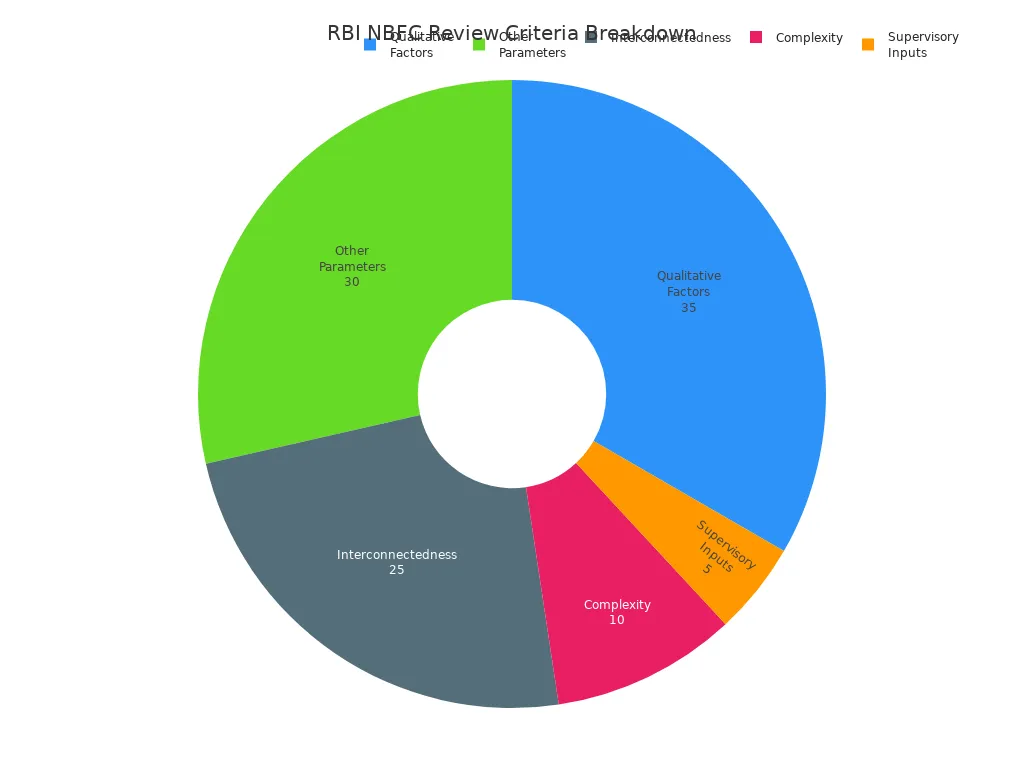
After you send your application, the RBI will check your company. The RBI looks at your company’s size, links with other companies, how hard your work is, and your group structure.
Criteria Type | Percentage | Description |
|---|---|---|
Qualitative Factors | 35% | Size |
Interconnectedness | 25% | Connections among entities |
Complexity | 10% | Complexity of operations |
Supervisory Inputs | 5% | Inputs from supervisory authorities |
Other Parameters | 30% | Liabilities, group structure, segment reach |
The RBI also checks your directors’ backgrounds, your business plan, and if you follow all rules.
Receive NBFC License
If you pass the RBI check, you will get your NBFC license. It usually takes about 4-6 months after you send your application. You can then start your NBFC business.
Note: You must follow all RBI rules and keep your papers up to date even after you get your license.
If you want to know how to make a NBFC in India, you must do each step carefully. Good paperwork and following the rules will help you avoid problems and delays. This guide gives you a clear way to make a NBFC in India and start your finance business.
Post-Registration Compliance

Once you get your NBFC license, you must follow many rules. These rules keep your NBFC safe and legal. If you skip these steps, you can get big fines or lose your license.
Annual Filings
Every year, you need to send forms and returns. These show your money status and help the RBI check your NBFC. Here is a table with some important yearly filings:
Form | Types of NBFC | Description | Due Date |
|---|---|---|---|
DNBS-02 Return | Non-NDSI NBFCs | Shows financial details and asset data | By May 30th (audited/provisional); audited within 30 days of finalization |
DNBS-010 | All NBFCs & ARCs | Checks if you follow rules | Within 15 days of balance sheet finalization, no later than October 31 |
You also need to do these things each year:
Send unaudited and audited March monthly returns (NBS7).
Give a certificate from your auditor about income and assets.
Share details about foreign money or FDI.
Pass a board resolution to not take public deposits.
File your audited balance sheet and profit & loss account.
Get a statement from auditors to work for your company.
Note: If you miss these filings, you can get fined, lose your license, or face more checks.
Penalty Type | Description |
|---|---|
RBI can give you money penalties. This can hurt your NBFC. | |
License Revocation | RBI can take away your license and close your NBFC. |
Increased Regulatory Scrutiny | If you make mistakes often, RBI will check you more. |
Regulatory Reporting
You must report frauds and thefts fast. If you find fraud, tell the RBI in 14 days. For thefts, inform the Fraud Monitoring Group in 7 days. You also need to tell the police right away. If your group companies have fraud, report this to the RBI too. Every year, show the total fraud amount in your financial statements.
Ongoing RBI Requirements
You must keep following RBI rules after you register. Here are some things you must do:
Always keep the minimum net owned fund.
Follow rules for capital, asset quality, and liquidity.
Update your Fair Practices Code and digital lending rules.
Answer RBI checks and audits.
Keep all records and papers ready for review.
Following the rules keeps your NBFC safe and helps people trust you and the regulators. 🛡️
Practical Tips and Common Pitfalls
Mistakes to Avoid
Starting your NBFC can be exciting. But you need to be careful and avoid mistakes. Many people make errors that slow things down or get their application rejected. Here are some things you should not do:
Do not send in wrong or missing documents. If you forget even one paper, your application will be delayed.
Make sure your business plan is strong. The RBI wants a clear plan with good research and real numbers.
Always follow RBI rules. You must keep up with new changes and never ignore any rule.
Check if all directors are allowed. Every director needs a clean CIBIL record and the right experience.
Show proof of the net owned fund. You must have enough capital when you apply.
Keep your records neat and tidy. Messy files make it hard to answer RBI questions fast.
Tip: Check your papers and business plan twice before you send them. This can help you save time and avoid problems.
Benefits of Professional Consultancy
The NBFC registration process can be hard and take a lot of time. Getting help from experts can make things much easier for you. Here is how professionals can help:
Experts do the hard paperwork for you. They make the application simple.
Consultants know RBI rules very well. Their knowledge helps you not make mistakes.
You save time because they guide you at every step.
Experts fix problems quickly. This means your application can get approved faster.
Consultants know all the forms and papers you need. This helps you not miss anything.
If you feel confused or stuck, you can ask a trusted consultancy like Nishtha Leasing for help. Their team can answer your questions and help you avoid mistakes.
If you watch out for these mistakes and think about getting expert help, your NBFC registration can be much easier and more successful.
Co-lending and Consultancy with Nishtha Leasing
Co-lending Options
You can grow your NBFC business faster with co-lending. Co-lending lets you work with banks and other financial companies. You share loans and risks. This model helps you reach more customers and offer better interest rates.
Here are some benefits of co-lending with Nishtha Leasing:
You get access to bigger funds.
You can serve more people, even in remote areas.
You share risks with your partner bank.
You follow RBI rules for co-lending.
Tip: Co-lending helps you offer loans to small businesses and individuals who may not get help from banks alone.
Nishtha Leasing offers flexible co-lending options. You can choose from different loan products. You can also set your own terms with your partner. The team at Nishtha Leasing guides you through the process. They help you understand the paperwork and RBI guidelines.
Co-lending Feature | Benefit for You |
|---|---|
Shared Loan Portfolio | Lower risk, higher reach |
Joint Underwriting | Better credit checks |
Flexible Terms | Custom loan products |
RBI Compliance | Safe and legal operations |
How to Contact Nishtha Leasing
You can reach Nishtha Leasing easily. The team answers your questions and helps you start your NBFC or co-lending journey.
Phone: Call +91-9876543210 for quick support.
Email: Write to info@nishthaleasing.com for detailed queries.
Website: Visit www.nishthaleasing.com to fill out a contact form.
Office: Meet the team at Nishtha Leasing Pvt Ltd, 123 Finance Street, New Delhi, India.
📞 You get expert advice and step-by-step help when you contact Nishtha Leasing.
You can ask about NBFC registration, co-lending options, or compliance support. The team helps you avoid mistakes and grow your finance business.
You can start your NBFC journey by following these key steps:
Follow all RBI rules to avoid penalties.
Keep the required net owned fund.
Pick the right NBFC type for your goals.
Protect customer data and follow privacy laws.
Careful documentation and full compliance keep your NBFC safe. If you want expert support, Nishtha Leasing can guide you. Take the first step and begin your NBFC registration today! 🚀
FAQ
What is the minimum capital required to start an NBFC in India?
You need at least ₹10 crore as net owned fund to register a new NBFC. This rule helps you show financial strength and meet RBI standards.
How long does the NBFC registration process take?
You usually get your NBFC license in 4 to 6 months after you submit all documents and fees. Delays can happen if you miss paperwork or make mistakes.
Can you register an NBFC without professional help?
You can try to register your NBFC on your own. However, expert consultants help you avoid errors, speed up approval, and understand RBI rules better.
What happens if you miss annual filings or compliance?
If you miss filings, RBI can fine you, revoke your license, or increase checks on your NBFC. You must file all returns and follow rules to keep your business safe.